In short
People often talk about the "French-speaking market" as if it were one block. For an SME prospecting from Lille, Liège, Lausanne or Luxembourg, that is a mistake you pay for from the very first message. The method is the same everywhere: target, observe, write about the prospect rather than yourself, follow up. What changes is how it is carried out, country by country.
I worked for nine years in Belgium, as a lifeguard at Center Parcs, Equalia and Récréa, before moving into sales. It was not a sales job, and I do not claim to draw rules from it. What follows rests on verifiable facts (official languages, registers, legal rules), not on travel impressions.
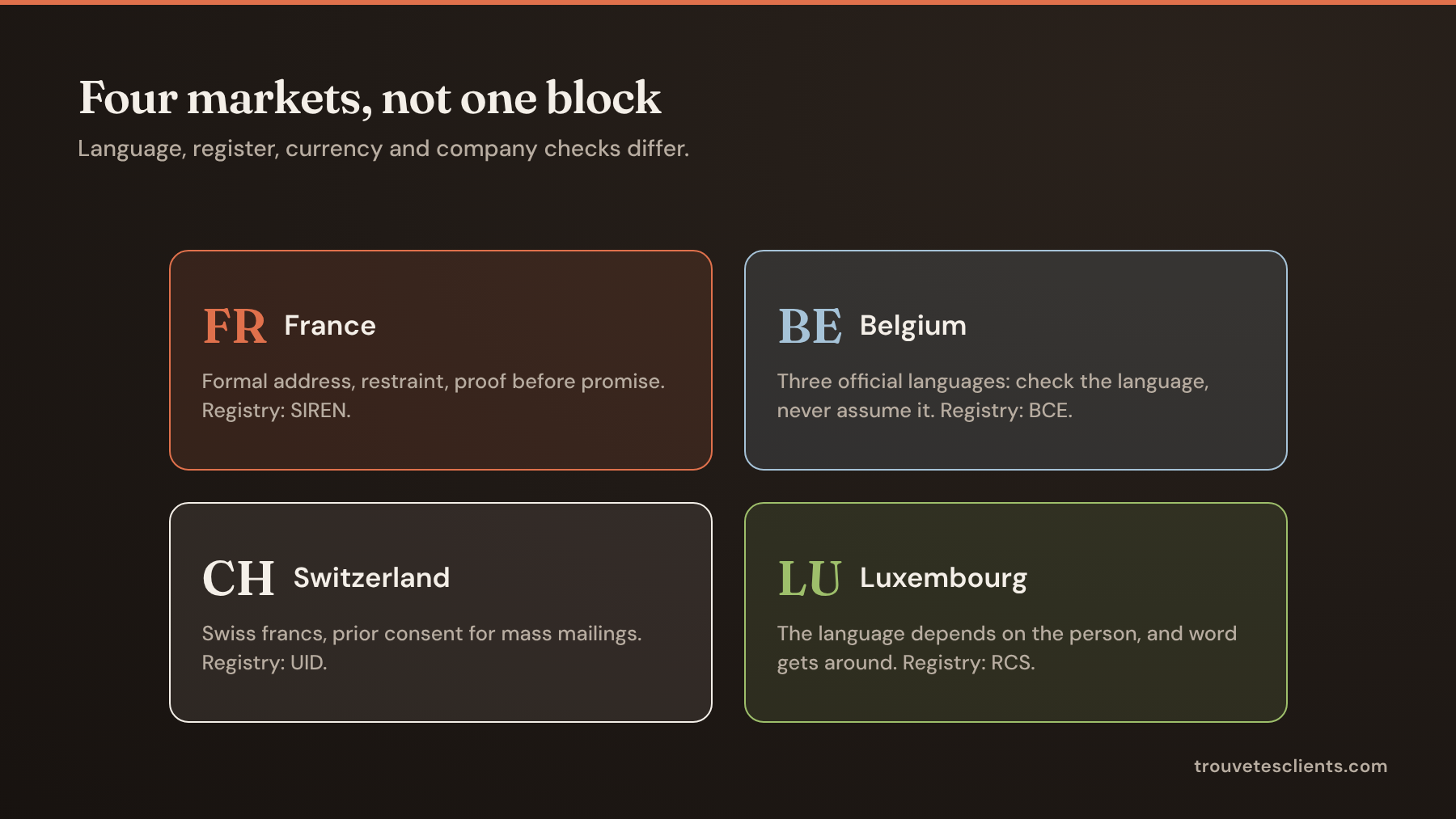
Five settings to check before writing
For every prospect outside your own country, go through five points: the working language, the register, the currency and formats, the company register where you can check the business, and the sending rules. The following sections cover them country by country.
Belgium: the language is checked, not assumed
Belgium has three official languages: Dutch (Flanders), French (Wallonia) and German (the German-speaking Community, in the east). Brussels is officially bilingual, French and Dutch. A company based in Ghent or Antwerp works, in principle, in Dutch. Writing in French to a Flemish managing director without having thought about it is clumsy at best.
In practice:
- Look at the language of the profile, the posts and the company website.
- In Dutch, start with "u" at first contact, and move to "je" if the other person does.
- To check a company, the reference is the Crossroads Bank for Enterprises (BCE in French, KBO in Dutch), which gives every business a ten-digit company number.
A detail that matters in Belgian French: people say "septante" (seventy) and "nonante" (ninety). Nobody will hold it against you if you write "soixante-dix", but a message that uses local conventions shows you know the ground. Choosing the language prospect by prospect, and the conventions of Flemish Dutch, are covered in prospecting in Belgium, in French and in Dutch.
Switzerland: four national languages, a currency of its own
Switzerland has four national languages: German, French, Italian and Romansh. The German-speaking part is the most populous. If you target "Switzerland", you are first and foremost targeting a market that works in German. In French-speaking Switzerland, French remains the working language, with its own conventions ("septante", "nonante", and "huitante" for eighty in some cantons such as Vaud). The conventions of the German-speaking market (standard German, "ss" instead of "ß", Zefix) are covered in prospecting in German-speaking Switzerland.
Three points to settle:
- The currency. Think in Swiss francs (CHF). An order of magnitude in euros signals that you come from elsewhere. Amounts are often written with an apostrophe as the thousands separator: 12'000 CHF.
- The register. In German, always "Sie". In French, the formal "vous" and a restrained tone; overt enthusiasm goes down badly.
- Checking the company. Every business has a UID number in the format CHE-123.456.789, which can be looked up in the central business name index (Zefix).
Luxembourg: a small market where word gets around
Luxembourg has three administrative languages: Luxembourgish, French and German. English is widely used in finance and international roles, and a large share of employees are cross-border commuters from France, Belgium or Germany. The language of the person you are writing to therefore depends more on the individual than on the country.
Two consequences:
- Do not assume the language. The profile and posts are your best clues. Failing that, French remains a common working language.
- Take care over every message. In a market of this size, decision-makers in the same sector know each other. A clumsy approach gets talked about.
To check a company, the reference is the Trade and Companies Register (RCS), kept by Luxembourg Business Registers: numbers start with a letter, for example B for commercial companies. To work this small market where decision-makers know each other, see prospecting in Luxembourg.
France: formal address, restraint, proof before promise
In France, the first B2B contact uses the formal "vous", without exception. SME leaders there receive a great many approaches and read anything that looks like a promise with suspicion. A precise observation about their company or a relevant question opens more doors than a list of benefits.
To check a company, the SIREN number and the public legal data (directors, declared headcount, turnover where published) are enough to tell whether it matches your target.
The sending rules are not the same
France and Luxembourg allow B2B prospecting email without prior consent, if the message concerns the recipient's role and they can easily object. Belgium applies the same GDPR, but the Royal Decree of 4 April 2003 limits this exception to the impersonal email addresses of legal entities (info@, contact@): for a named address, the most common reading requires prior consent, so LinkedIn or the generic address is the more careful route. Switzerland is not in the European Union, and its Unfair Competition Act requires prior consent for mass advertising by electronic means. The details are in what the GDPR really allows in B2B prospecting.
On LinkedIn, one rule applies everywhere: no tool that sends messages or collects profiles on your behalf, and an invitation volume well below what the platform tolerates, around 100 per week.
Organise your list by country
In your prospecting file, add two columns: "country" and "working language". Then write one first-message template per country and language pair, and personalise each send. Compare reply rates by country rather than as a single overall figure: a message that works in France may well fail in Flanders, and the average will hide it from you. The calculation method is in measuring your LinkedIn reply rate.
An honest note on tooling: in Trouve Tes Clients, automatic enrichment of company data currently covers France only; in Belgium, Switzerland and Luxembourg, checks go through the public registers mentioned above.