In short
Most SMEs that prospect already have the pieces of a system: a list in a spreadsheet, a few messages that work, a diary. What they lack is the link between those pieces. Prospects are not lost within a step. They are lost between two: a signal spotted but never used in the message, a reply received but never followed up.
A prospecting system is five steps, each of which passes something specific on to the next: target, understand, personalise, prospect, manage. To put these five steps on a quarterly calendar, see preparing your first-quarter prospecting plan. To put them in place over a first month, week by week, see starting LinkedIn prospecting in an SME in 30 days.
What prospecting without a system looks like
In August 2021, in my first week as a residential property salesperson at Efficity, I sent 60 copied-and-pasted LinkedIn messages. I got a single reply: "You're all the same."
The message was not the only problem. I had not chosen anyone: I wrote to whoever came up. I knew nothing about these people, so I could say nothing specific to them. And I had planned no follow-up. The three steps before the message and the one after it were all missing.
1. Target: decide who you will not write to
Targeting starts with a definition of your ideal customer: sector, company size, the decision-maker's role, and above all the reason they buy. If that definition does not fit easily into one sentence, writing your ICP in one sentence is the right place to start.
This definition then serves as a filter. Each prospect gets a simple fit score, and those clearly off target leave the list before any writing begins. A list of forty well-chosen decision-makers is worth more than a list of four hundred names.
What this step passes on: a short list, sorted by relevance.
2. Understand: find the reason to write now
For each prospect you keep, you need a reason to write today rather than six months ago. The high-value signals are well known: an appointment, ongoing recruitment, a new site, a recent talk or post, a funding round. The number of LinkedIn connections or a list of generic skills tells you nothing.
The company's context matters as much as the person's: size, activity, recent changes. For French companies, data from the trade and companies register gives a reliable base. Elsewhere, the company page and website remain the best sources.
What this step passes on: for each prospect, a signal and two or three lines of context.
3. Personalise: one approach per prospect
The first message opens on the signal from the previous step, not on your company. It is written in the prospect's language and in the right register: you use the formal "vous" with a French managing director, "Sie" with a German-speaking contact. An observation, a point from the field, an open question: three parts are enough.
The difficulty is not writing one good message. It is writing forty that all ring true. That is where assistance makes sense, provided you reread every message. Concrete examples are annotated in first LinkedIn messages: annotated examples.
What this step passes on: a ready message, specific to each prospect.
4. Prospect: send and follow up methodically
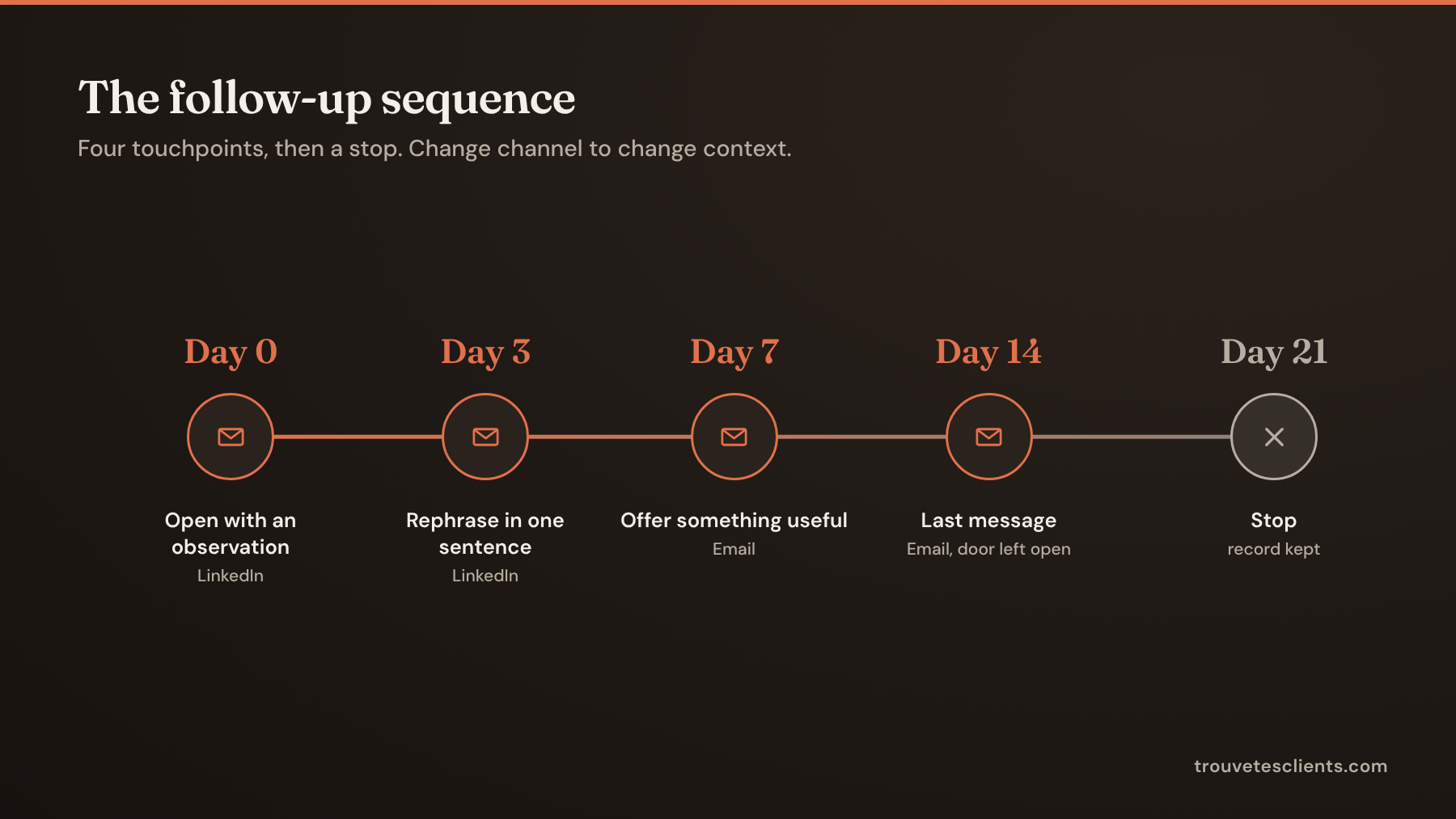
A single message gets lost. The sequence organises follow-ups over time and, where relevant, across several channels:
- Day 0: first contact on LinkedIn;
- Day 3: a one-sentence follow-up, from a different angle;
- Day 7: something useful by email, with no request;
- Day 14: last message, announced as such;
- Day 21: stop, record kept.
On LinkedIn, sending remains your action. The platform's terms of use prohibit automation, and it is wise to stay below what it tolerates for invitations, around 100 per week. The content of each touchpoint is covered in detail in the sequence on LinkedIn, by email and on WhatsApp.
What this step passes on: replies, and the date of each next action.
5. Manage: know who is where
This is the step that breaks down most often. Without tracking, a "get back to me in March" reply is forgotten by April, and two people in the same team write to the same prospect.
Managing comes down to a few things: for each prospect, a status, the date of the last exchange and the dated next action. Once a week, look at where prospects drop out of the system. If many are qualified but few reply, the problem lies in the message. If they reply but do not accept a meeting, it lies in the proposal. The useful indicators are described in measuring your reply rate on LinkedIn.
This tracking does not call for heavy software at the start. A shared spreadsheet with these three columns, opened every Monday morning, already makes the difference. A tool becomes useful when the volume makes manual review too slow, not before.
The meeting is not the end of the system, it is its measure. When the interest is real, suggest a specific slot rather than "when are you available?", then prepare the call.
This is the chain Trouve Tes Clients organises in a single workspace, and we start with a diagnostic of your current prospecting.