In short
Most SMEs that "try LinkedIn" do it the same way: someone sends a wave of invitations on a Monday, with the same message to everyone, and then nothing for three weeks. The channel did not fail. It was never tested.
Starting LinkedIn prospecting in an SME means running a short, bounded first month, split into four weeks, each with a deliverable you can check. You do not need to hire, nor a tool that sends on your behalf. Thirty days is also the minimum time to get readable numbers: one week is not enough, because the follow-ups have not happened yet, and they bring in a good share of the replies.
This article covers only that start. For the organisation that follows, once the channel is validated, see how to organise an SME's LinkedIn prospecting over time.
What I learned by botching my first send
August 2021, first week at Efficity. I sent 60 LinkedIn messages, all copied and pasted. I got a single reply: "You're all the same."
That prospect was right. Nothing in my message showed I knew who he was. The problem was neither the channel nor the volume: it was the lack of preparation. Everything that follows is there to avoid that scenario.
The frame for the month: one hour a day, a volume LinkedIn accepts
The plan is meant for a managing director or head of sales who keeps the rest of their work going in parallel. Allow about one hour per working day, a little more in the first week.
LinkedIn caps invitations at around 100 a week for one account, sometimes less on a recent or inactive profile. The plan stays well below that: about twenty in week 2, then 50 to 75 a week. That is not a handicap. At this pace, every name on the list has to earn its place.
Do not use any extension or tool that sends, visits or collects profiles on your behalf: it breaches LinkedIn's terms of use, and it is the surest way to get the prospecting person's account restricted. For an SME leader, that account cannot be replaced.
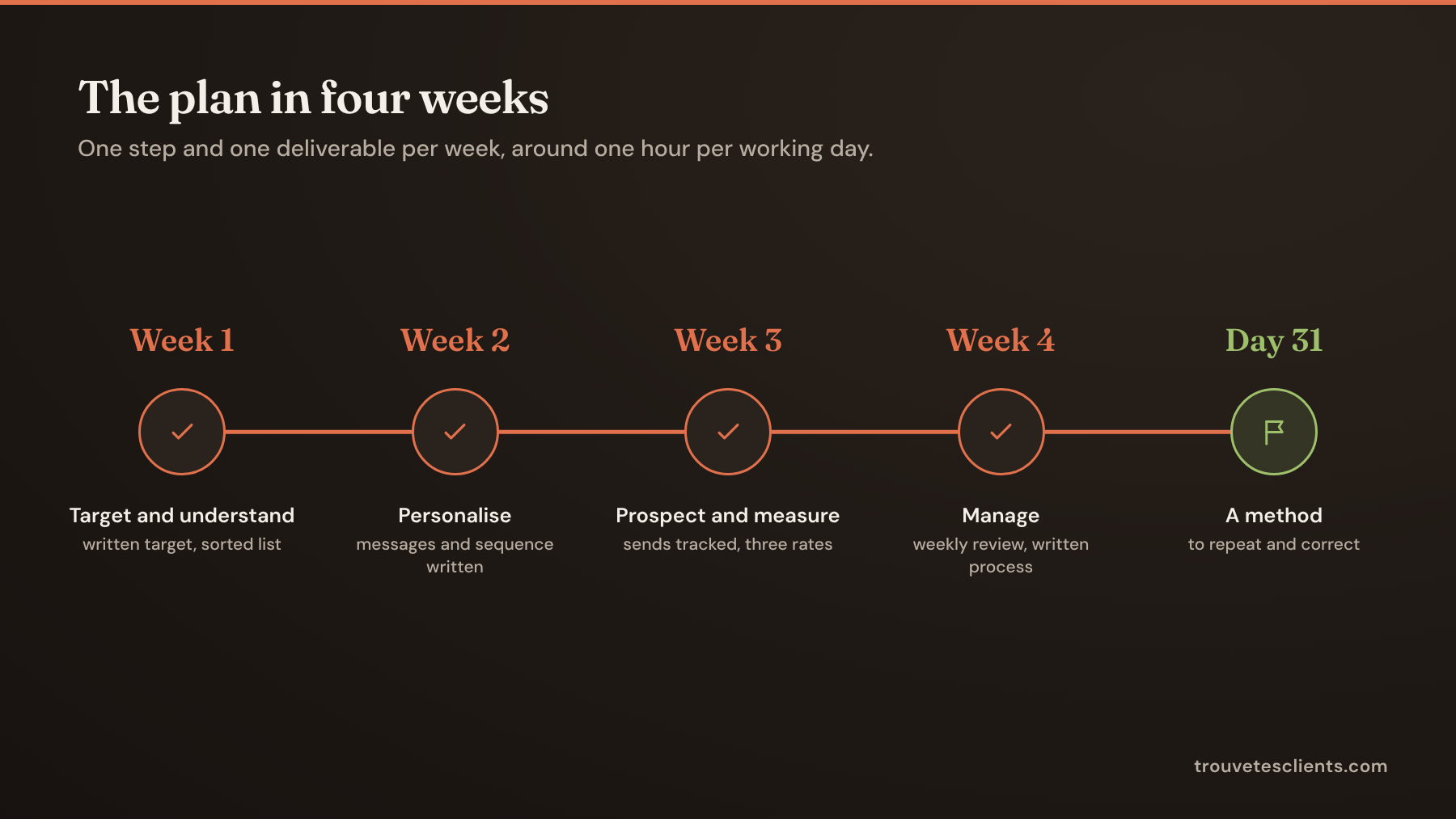
Week 1: target and understand (days 1 to 7)
Everything else rests on this week. A vague target produces lukewarm messages, low rates, and numbers nobody knows how to interpret.
Choose a single segment, not "SMEs"
The first month tests a hypothesis, and a hypothesis needs a narrow target. A segment is described by three criteria:
- A sector (for example: accounting firms, precision-engineering subcontractors, independent estate agencies).
- A size, in headcount or turnover.
- A decision-maker role: the person who signs for what you sell.
Pick the segment where you already have happy clients. You know its vocabulary, its problems and its objections. To phrase the target, start by writing your ICP in one sentence, then turn that sentence into criteria you can observe on a profile: size, sector, role, time in the role, recent activity.
Decide who writes, and prepare their profile
In an SME, the most-read message is often the managing director's. A business owner replies more readily to a peer than to an unknown profile. At the start, then, the managing director or head of sales writes, from their own account. Before replying, the prospect will click on that profile. Check three things:
- The headline says what the company does and for whom, not just "Managing Director". Example: "Forklift maintenance for logistics warehouses, Hauts-de-France".
- The About section can be read in ten seconds: the problem you solve, for which type of client, and how to reach you.
- Recent activity has not been empty for two years. One useful comment under a post from your sector is enough to show the account is alive.
Build a sorted list, company by company
Build a list of 150 to 200 decision-makers in the segment, sorted by fit with the target: that is a month's worth of invitations, no need for more. For the first 30 to 40 companies, note in a spreadsheet:
| Column | Why | |---|---| | Company, town | Avoid duplicates, group by area | | Contact and role | The decision-maker, not the first name you find | | Recent signal | Hiring, new site, post, change of role | | Status | Invited, connected, in conversation, meeting, no follow-up | | Next action and date | Follow up at the right time |
The "recent signal" column is the one that will make your message. If you find nothing to say about a company, it is not a priority this month.
A note outside France: the legal information on a French company (headcount, activity, directors) is available in public registers. In Belgium, Switzerland and Luxembourg, you usually have to look it up by hand in the relevant national register. Plan for that time.
End-of-week deliverable: a one-sentence target, a grid of criteria, a profile ready, a sorted list.
Week 2: personalise (days 8 to 14)
This week is mostly for writing. A follow-up written on the day it is due is usually a poor one: the whole sequence is written before the first send.
A first message about the prospect
The first message does not introduce your company. It shows you have looked at theirs. Compare:
"Hello Ms Leroy, I hope you don't mind me getting in touch. Our company offers maintenance solutions…"
"Hello Ms Leroy, I saw you're opening a second warehouse in Lesquin. When a site starts up, the question of forklifts often comes up late. How did you plan for it?"
The second sells nothing. It asks a question the person can answer and that touches on your subject. You will find more examples, with their flaws and fixes, in first LinkedIn messages, annotated.
A simple rule: if the message could go to someone else by changing only the name, it is not ready. Test it on about ten real profiles from the list: does it still make sense for each one, once the observation is swapped?
The follow-up sequence, written in advance
A first message without a follow-up leaves most conversations stalled, simply because the prospect was busy that day:
| When | Role of the message | |---|---| | Day 0 | First message: observation and question | | Day 3 | Short follow-up recalling the question | | Day 7 | Something useful (a lesson learned, a resource), without selling | | Day 14 | Last attempt, door left open | | Day 21 | Stop: no reply is a reply |
Each follow-up brings something new. "Just following up" with nothing else adds nothing. Follow-ups can switch channel when you have a business email address: the principle is explained in the multichannel LinkedIn, email and WhatsApp sequence.
At the end of the week, send a first wave of about twenty invitations, with no note or with a one-line note that sells nothing.
Deliverable: one message per segment, a written sequence, a tracking file ready, a first wave sent.
Week 3: prospect and measure (days 15 to 21)
You launch, at a pace you can keep in the following months.
- Send 10 to 15 targeted invitations per working day, starting from the top of the list, without going over 75 a week.
- Reply the same day. A late reply cools down a conversation that had just opened.
- Qualify instead of presenting the offer: what is the problem, who decides, is it a priority right now. The criteria are in qualifying before accepting a meeting.
- Send the follow-ups on their date, and log each contact, their status and their dated next action.
- Record three rates at the end of the week: acceptance, reply, qualified replies.
Deliverable: every conversation tracked, follow-ups sent on time, three rates measured.
Week 4: steer (days 22 to 30)
This is the week that turns a series of efforts into a system.
- Suggest a call only when the person has shown real interest. A meeting obtained out of politeness fills your calendar without moving your revenue.
- Set up a fixed weekly review, half an hour, always on the same day: overdue actions, the week's rates, a single decision.
- Fix the weakest link, and only that one. Low acceptance: review the targeting. Low replies: review the opening of the message.
- Keep sending and following up at the same pace as in week 3.
- Write your process on one page: who does what, when, with which messages. That is what will let you hand it over to a colleague one day.
Contacts with no reply at day 21 are closed. The review is done on the complete cohort: since the last invitations go out at the end of the month, their follow-ups fall after day 30, and you count 21 days after the last send.
Deliverable: a ritual in the calendar, a first fix, a one-page process.
Reading your numbers: a worked example
Here is a worked example, with rates chosen for illustration and not observed at a client. About twenty invitations in week 2, then 60 a week in weeks 3 and 4: 140 invitations over the month.
| Step | Calculation assumption | Volume | |---|---|---| | Invitations sent | 20 + 60 + 60 | 140 | | Connections accepted | if 30% accept | 42 | | People who reply | if 20% reply | 8 | | Qualified conversations | if 1 in 3 is in the target | 3 | | Meetings | if half accept a call | 1 or 2 |
This table does not say what you will get. It shows how rates multiply: if your acceptance rate halves, everything else halves. That is why the list matters more than the wording.
Replace the assumptions with your own numbers. Count per person contacted, not per message sent. The full method is in measuring your reply rate.
What makes the result vary
Targeting. An approximate list drags down every line of the table. It is the first place to look if the numbers disappoint.
Follow-ups. Without them, the sequence stops at day 0 and you only measure part of what the list could give.
Regularity. One hour a day for thirty days beats a full-time week followed by giving up. If you skip a day, do not double up the next day, especially not on invitations: just resume the plan where it was.
One variable at a time. The following month, change either the target or the first message, never both. Otherwise you will not know what made the difference.
Tick off the milestones as you go (progress is saved in this browser):
After day 30
You are not starting from scratch. You have a written target, an enriched list, real rates and a one-page process. The next month becomes an iteration: one fix per week, a review every Friday. This plan does not guarantee precise numbers, because they depend on your market and your offer. It gives you the ability to know why they go up or down.
For the overview of the five steps this month puts in place, see the B2B prospecting system in five steps. If the segment does not respond, change segment before changing tools. For an outside look at your target and your messages before you launch, that is what the Trouve Tes Clients prospecting diagnostic is for.